Court of Session allows appeals against two decisions of the Scottish Information Commissioner
Information & Data Protection, Public Law & Judicial Review
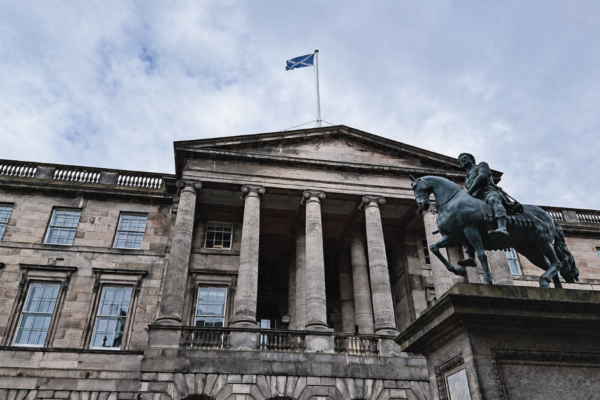
On 30 October 2026, the First Division of the Inner House of the Court of Session allowed appeals by the Scottish Ministers against two decisions of the Scottish Information Commissioner. The successful appellants were represented by Paul Reid KC and David Welsh, instructed by the Scottish Government Legal Directorate.
The ruling provides welcome clarity on the interaction between freedom of information rights and court orders designed to protect complainers in criminal and civil proceedings from “jigsaw identification”.
The full decision of the court can be found here.
Background
The appeals were made under the Freedom of Information (Scotland) Act 2002 (FOISA) in relation to requests seeking written and oral evidence submitted to James Hamilton (the independent adviser on the Scottish Ministerial Code) during his 2021 investigation into former First Minister Alex Salmond.
The Scottish Ministers withheld certain information under section 26(c) of FOISA, which provides an absolute exemption if disclosure of information would constitute, or be punishable as, a contempt of court. The Ministers argued that releasing the information, when combined with existing public knowledge, would breach strict anonymity orders and undertakings granted by the court to protect complainers in previous judicial review, criminal, and civil proceedings.
Following applications for a decision on the matter, the Scottish Information Commissioner issued decision notices. In those notices, he accepted that some withheld material was exempt, but ordered the disclosure of other information on the basis that, while it might permit assumptions regarding the complainers’ identities, it would not allow for the “definitive confirmation or refutation of such assumptions”. The Ministers appealed to the Court of Session under section 56 of FOISA. (FOISA appeals do not go to the tribunal system; they go to the Inner House of the Court of Session.)
Grounds of Appeal
The Scottish Ministers advanced two primary grounds of challenge:
- The Commissioner’s Role: The Commissioner erred by treating himself as the final arbiter of what constitutes contempt of court rather than assessing whether the Ministers had a proper basis to invoke section 26(c).
- The Legal Threshold for Contempt: The Commissioner applied an incorrect legal test by requiring information to provide definitive confirmation of identity. Under the governing authorities, any disclosure creating a real or substantial risk of jigsaw identification breaches court orders and amounts to contempt.
Decision of the Court
Delivering the opinion of the court, the Lord President (Pentland) rejected the first ground of appeal but upheld the second, finding that the Commissioner had committed an error of law by setting the threshold for contempt too high.
The Correct Test for Jigsaw Identification and Contempt
Murray v HM Advocate [2022] HCJAC 14, a decision of the Scottish criminal appeal court, established that the orders prohibited information “likely to disclose the identity” of complainers aims to protect their dignity, privacy, and safety from targeted abuse or harm within their communities.
Contempt does not require strict probability or definitive proof; rather, if deliberately published material produces a real or substantial risk of identification to a section of the public, that is determinative.
The court found that the Commissioner’s reasoning—requiring information to definitively confirm or refute existing assumptions—imported an unwarranted standard of certainty. Because the Commissioner already accepted that the disclosed information would permit assumptions to be made, he logically established a real risk of identification. Permitting assumptions to be made undermines the protective objective of court orders and constitutes a material misdirection in law.
Outcome and Disposition
The court allowed the appeals, quashed the Commissioner’s decisions insofar as they ordered the disclosure of material withheld under section 26(c), and remitted the matters back to the Commissioner to reconsider in light of the court’s opinion and the principles set out in Murray.
Importance Beyond Scotland
This decision provides welcome reasoning regarding the statutory interface between transparency laws (such as FOISA and the Freedom of Information Act 2000) and court-mandated reporting restrictions, particularly in the difficult area of jigsaw identification. It reinforces the principle that freedom of information regimes cannot be used to subvert judicial protections.
By aligning freedom of information compliance strictly with criminal law thresholds on contempt and jigsaw identification, the judgment ensures that public authorities maintain the absolute shield to withhold information where disclosure poses a real or substantial risk to the safety, privacy, and anonymity of vulnerable participants in legal proceedings.