COP31 Deep Dive: What Collapsed and What Didn’t
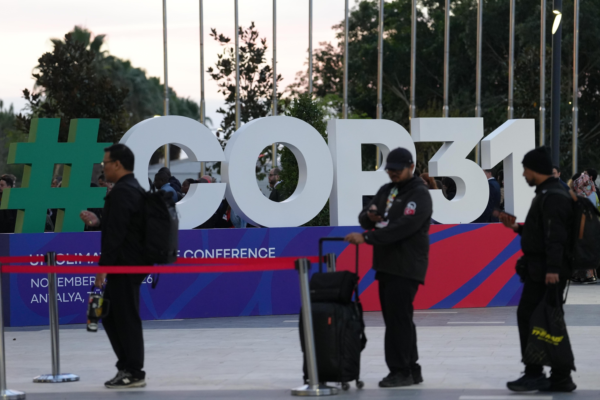
COP31 closed without a cover decision. This Deep Dive looks at why and at what was agreed in Antalya
COP31 ended on Sunday 22 November, nearly 50 hours after its scheduled close, making it the longest COP in history. It ended without the overarching political statement, known as the “cover decision”. The proposed “Antalya Pact” was rejected in the closing plenary by the EU, the UK and a group of other climate-vulnerable countries, chiefly because it no longer mentioned fossil fuels.
That failure is stark, in the context of a COP that acknowledged inevitable overshoot of 1.5°C of warming, with the dangerous climate impacts that necessarily entails. But it is not the only story of COP31. A long list of negotiated decisions was adopted in the same plenary, on just transition, adaptation, climate finance and carbon markets among others. The COP28 commitment to transition away from fossil fuels in energy systems also stands untouched. As one veteran observer put it to Carbon Brief, this was the first time that “those who want a higher level of ambition actively reject[ed] the lowest common denominator on offer”. Several eNGOs have commented that no deal was better than a bad deal.
For the background, see our pre-COP briefing.
How the Antalya Pact fell
The Presidencies announced at the Pre-COP in Fiji that they would pursue a “presidency-led” cover decision. Australia wanted a short text responding to the imminent overshoot of 1.5°C. Türkiye saw it as the vehicle for its “35 by 35” electrification goal. What followed was a text that shrank at every turn:
- 16 November: “reflections”. A 144-paragraph compilation of everything Parties had asked for. It called for an “immediate” transition away from fossil fuels, welcomed Brazil’s roadmaps, and put USD 120bn on tripling adaptation finance.
- 19 November: first full draft. Cut to 80 paragraphs. Every mention of fossil fuels and the USD 120bn figure had gone. “35 by 35” survived only as one item on a menu of options, alongside numerical targets for carbon capture, apparently offered as a quid pro quo.
- 22 November, 3am: “final” draft. Still no fossil fuels or adaptation figure, and the call for the next IPCC reports to arrive before the second Global Stocktake was dropped. A 126-country coalition, including the EU, UK, the Alliance of Small Island States (AOSIS), the Like-Minded Developing Countries (LDCs) and the Umbrella Group, asked for a direct link back to the first stocktake and for the carbon capture targets to go.
- 22 November, afternoon: the Antalya Pact. Only minor changes. Carbon capture was to be “increased” rather than “accelerated”.
At least 32 countries rejected the text in plenary. The EU said it would not endorse a pact “that does not even mention fossil fuels, which is the key driver of climate change”. Panama, the Marshall Islands, Belize, Norway and Vanuatu also objected. The LDCs, the UK, South Korea and Japan said that consensus had not been reached.
Not everyone opposed the text. Ghana, for the African Group, said it could have supported it. Saudi Arabia, for the Arab Group, objected to carbon capture being called greenwashing. Russia restated its opposition to “any wording on fossil fuels”, despite the language agreed by consensus at COP28.
The end of the cover text?
The most interesting question coming out of Antalya may be whether COPs should keep trying to agree cover texts at all.
Nothing requires them. A cover decision is a political statement layered over the negotiated agenda items, and for many years COPs managed without one. The recent run of them, from Glasgow and Sharm el-Sheikh to Dubai, Baku and Belém, set a precedent but not a rule. This year it was the Presidencies’ choice to push for one, and that choice is what failed. Russia questioned the legal basis for a cover decision that was not on the agenda. India, for the LDCs, complained that it had taken attention away from the mandated items. Observers estimate that more than twice as much negotiating time went on the cover text as on those items in week one.
The architecture is largely in place: Paris itself, followed by the finance, forest and fossil fuel commitments made at Glasgow, Dubai and Baku. So the focus could shift to implementing what has already been agreed. The Presidency’s own consultations on reform heard calls for “avoiding unnecessary cover decisions”.
Juiciest titbit (for lawyers): a retreat from cover texts may be an unintended consequence of the ICJ’s advisory opinion of 23 July 2025. The Court found that COP decisions, notably the Glasgow Climate Pact at COP26, express the Parties’ agreement in substance on how Articles 2 and 4 of the Paris Agreement are to be interpreted. That makes them “subsequent agreements” under Article 31(3)(a) of the Vienna Convention on the Law of Treaties. It was on that basis that the Court concluded that 1.5°C is the Parties’ agreed primary temperature goal, giving rise to legal commitments (see our analysis of that finding).
The implication is that cover texts are no longer just political signals. They can shape what the Paris Agreement legally requires. Some commentators warned that this could take away a tool negotiators had relied on, by making ambiguous political language legally loaded. Parties resisting stronger language on fossil fuels now have every reason to keep it out of anything that might later be read as an interpretive agreement. Parties seeking ambition have reason to refuse weak language that might be read as narrowing earlier commitments. Antalya showed both instincts at work. Even the first draft took care to welcome the advisory opinion only “without prejudice” to States’ legal positions.
If COPs move away from cover texts, the legally significant work will shift to the negotiated decisions under specific agenda items, and to coalitions of the willing outside the consensus process.
What was agreed
Much of what was adopted is procedural, but some of it matters.
| Area | Outcome |
| Just transition | A phased approach to the new just transition mechanism (the “Belém–Antalya Mechanism”). Its functions and operation will be worked out in Bonn in June 2027, with a view to formal agreement at COP32. Submissions close on 15 March 2027. “Critical minerals” appear in a COP decision for the first time, though human rights due diligence language was removed. |
| Adaptation | No figure or baseline for tripling adaptation finance. The Global Goal on Adaptation decision sets up an expert taskforce to refine the 59 Belém indicators: six experts per UN region, plus three each from the LDCs and small island states. It does not mention 1.5°C. |
| Adaptation Fund | Described as “one bright spot”. The Fund can now receive its 5% share of proceeds from the Article 6.4 carbon market, and developing countries keep a majority on its board. |
| Least developed countries | A new platform to support implementation of LDCs’ national adaptation plans. |
| Climate finance | Mostly procedural. The finance work programme will now run until 2028, not 2027 as some developed countries wanted. Decisions on long-term finance and Article 2.1c (aligning finance flows with climate goals) were also adopted. |
| Article 6 carbon markets | Agreement on both 6.2 and 6.4. An early draft expressed concern that reviews had found 543 “inconsistencies” in countries’ 6.2 reports, 115 of them significant. The final text only “takes note”. Funding for 6.2 infrastructure returns in 2027. |
| Loss and damage | The funding shortfall was “noted”, with a call to convert pledges into payments. New pledges were limited to €15m from Spain. The Fund’s first replenishment starts in 2027. |
What was not agreed
- The Mitigation Work Programme, the only agenda item dedicated to cutting emissions, was due to end in 2026. A near-final draft would have extended it to 2030, but it was blocked in the closing plenary. The sticking point was its link to the Global Stocktake: some Parties want to stop it feeding another “transition away from fossil fuels” moment into the stocktake at COP33. Discussions resume in Bonn.
- Guidance on NDCs. No agreement on further guidance for national climate plans. The talks ended under “rule 16”, so the item rolls to Bonn.
- Absent from the outcome altogether, after the cover text and the decisions on response measures and agriculture all fell. The African Group, Kenya and others signalled that it will be a priority at COP32.
- The decision on the second Global Stocktake is procedural. COP31 could not agree whether to start a third review of the Convention’s long-term goal either. The fight over whether the next IPCC assessment arrives before the stocktake in 2028 remains unresolved.
Beyond the negotiations
Much of the real momentum came from coalitions of the willing.
- Fossil fuels. Brazil formally handed over its roadmap for transitioning away from fossil fuels. Its COP30 President stressed that it is “not a mandate” but input for implementation. 30 countries support the roadmap. Ireland and Tuvalu confirmed the second conference on transitioning away from fossil fuels, following Santa Marta: a pre-conference in Dublin in May and the main event in Tuvalu in July 2027. Colombia’s Irene Vélez Torres summed up the mood: consensus “is not going to stop us anymore”.
- Kurum told the closing plenary that “around 80” countries back “35 by 35”, though no full list has been published. A new Electrify Now Finance Coalition aims to mobilise over USD 1.2bn for clean electrification in developing countries.
- USD 480m of new philanthropic funding was announced for methane and other super-pollutants. The UK was among nine countries endorsing a ministerial declaration to accelerate action towards the 30% cut by 2030 in the Global Methane Pledge.
- Twenty-five countries, including Brazil, Kenya, Fiji and the DRC, launched a Wildlife for Climate Declaration. It is the first joint push at a UN climate conference to recognise the role of wild animals in carbon sinks and resilience. The evidence is striking: forests with elephants in the Congo Basin store around 7% more carbon, and kelp forests guarded by sea otters can absorb 12 times more CO2. This is one on which to keep an eye at COP32 in Ethiopia, given how many of the signatory countries to the declaration are in Africa.
The UK’s position
The UK stood with the 126-country coalition pressing for stronger text, and refused to back the final Pact. In plenary it called the text “not commensurate with the urgency of overshoot, the scale of the climate crisis or the impacts already being felt”, and “the lowest common denominator”. Procedurally, it registered that consensus had not been reached, rather than lodging an outright objection.
The Government’s formal statement on the COP31 outcome was issued by the Department for Energy Security and Net Zero and Energy Secretary Miatta Fahnbulleh on 22 November. It says that the Presidencies’ cover decision does not “meet the moment” and “moves us backwards on the science when we must accelerate implementation”. Even so, the UK commits over the coming year to:
- speed up the transition away from fossil fuels, and protect forests;
- support clean electrification worldwide;
- pursue a meaningful process on adaptation finance, clarifying the baseline, tracking delivery and improving access;
- reform the COP process and uphold its integrity;
- protect the oceans;
- support mountain and glacier-dependent communities.
It promises to return to COP32 “with advances made, even stronger resolve and an improved COP process”.
Foreign Secretary Ed Miliband had foreshadowed this approach in a Q&A with Carbon Brief on 12 November. He is “quite pro the institution of the COP”, in part because it is where coalitions of the willing form. On Brazil’s fossil fuel roadmap, he acknowledged that some countries are obstacles, adding that “not every decision is going to get into the COP decision. But it doesn’t mean we can’t make progress”. Asked about Jackdaw, he pointed to the UK’s clean power 2030 target, its NDC and legislation for no new oil and gas licences. After the summit, First Secretary of State Louise Haigh called the COP “clearly a very flawed process”, but “the only one available to us”.
Other official UK material from Antalya:
- the Prime Minister’s national statement of 12 November, accepting that the world will now reach 1.5°C and naming the UK’s first special representative for climate security;
- the UK’s endorsement of “35 by 35” and its Clean Electrification Roadmap, published the same day;
- the written statement to Parliament of 3 November setting out the UK’s objectives;
- the UK’s statement at the briefing by the COP31 Presidency.
Not everyone is giving the UK credit. Friends of the Earth’s Asad Rehman welcomed the willingness to walk away from “a weak and woolly agreement”. But he said the UK and EU deserve “very little credit” for claiming to want to end fossil fuels while expanding their own projects, and for failing to help poorer nations. The UK’s G20 presidency in 2027, with climate resilience, debt and development reform on the agenda, will be watched closely.
The road to COP32
COP32 will be in Addis Ababa, Ethiopia, the first COP hosted by a least developed country. Prime Minister Abiy Ahmed has promised to put finance for developing countries at its centre. Key dates:
| Date (2027) | Event |
| 15 March | Deadline for views on the just transition mechanism |
| May | Pre-conference on transitioning away from fossil fuels, Dublin |
| 7–17 June | Bonn climate talks: mitigation, NDC guidance, just transition mechanism, reform of intergovernmental arrangements |
| 19–27 June | London Climate Action Week |
| July | Second conference on transitioning away from fossil fuels, Tuvalu |
| 8–19 November | COP32, Addis Ababa |